Wednesday, 21 October 2009

Debt-Deflation Still In Play

What will be the main trend in US equity markets and the dollar over the next 6 months?

1) Dollar Strength & Equity Strength. Probability: 1%

2) Dollar Weakness & Equity Strength. Probability: 13%

3) Dollar Weakness & Equity Weakness. Probability: 16%

4) Dollar Strength & Equity Weakness. Probability: 70%


Picking the correct number will be key to determining whether you make or loose money over the next six months. Below I give a brief summary of why I have assigned the respective probabilities. As you’ll see, whichever way you slice it, my outlook is grim, but a stronger dollar and weaker equities is my pick.

1) Dollar Strength & Equity Strength. We are currently in the early stages of a depression. This is just a plain fact. What is needed for the dollar to strengthen and stocks to rise in this depression, in spite of dollar strength, is a massive increase in the current rate of return on assets, which sees a return of capital back to the US. In the absence of rising financial leverage (unlikely due to the state of the banking sector) and with lower consumer spending guaranteed, this would require an almost impossible rise in productivity. Something akin to the dot.com boom cannot be entirely ruled out, however. 1%

2) Dollar Weakness & Equity Strength. This basically calls for a continuation of the current trend. Hyperinflation would certainly be consistent with this view, but it seems unlikely. What is slightly more likely is a steady decline in the dollar coupled with a continued rise in risk appetite backed up by improving US economic fundamentals, which all serve to prolong the current bubble. While this would not be sustainable, over a six month horizon it is certainly possible for it to continue. 12%

3) Dollar Weakness & Equity Weakness. This more realistic. The reasons to expect dollar weakness are all-too obvious, and while we have seen dollar weakness translate into equity strength in recent months this need not continue. In fact, as I write this post, the Dow is falling hard while the dollar is still weak (the Dow is getting KILLED in Aussie dollar terms, and the long-term downtrend is still in place). If emerging market demand for commodities remains strong and the Chinese revalue the yuan, commodities prices could rise substantially, squeezing companies’ top line growth and raising costs. While I don’t want to read to much into daily moves, I think it is significant that the Dow Transports rolled over today (not confirming the break-out according to Dow Theory) as oil spiked higher. While I would expect this trend to be short-lived, the period from H207 to H108 showed this relationship can go on for a long time.

4) Dollar Strength & Equity Weakness. This is my core view. True, I have held this view since Dow 9,000 and EUR1.4000/US$, but with the Dow now at 10,000 and the euro at EUR1.5000/US$, and the fundamentals unchanged, I like it even more. After all, the idea is to buy low and sell high is it not? I find it strange that people are jumping into the Dow now when they didn’t want any of it at 7,000, and are scrambling out of dollars when they couldn’t get enough of them at EUR1.3000/US$ a year ago.

Do you remember 12 months ago when the prevailing wisdom was that no matter what the government/Fed did to crush the dollar (and everyone new that’s what they were going to try and do), private sector deleveraging would ensure that the dollar continued to strengthen and asset prices continued to fall? If I had told you then that in less than a year’s time the Argentine Merval stock index would be pushing all-time highs, or that the AUD would be heading for parity against the dollar I’m pretty sure I would have been laughed at. Of course, I didn’t say those things. I was part of the consensus that thought the Fed could not overwhelm the natural deflationary pressures at play, and that the trend of deflation would continue. As far as I could see the Fed was just ‘pushing on a string’.

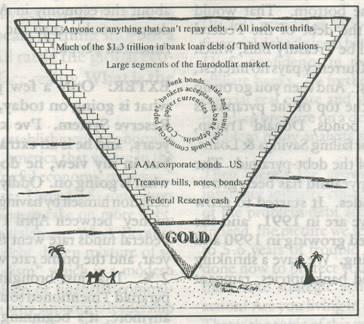
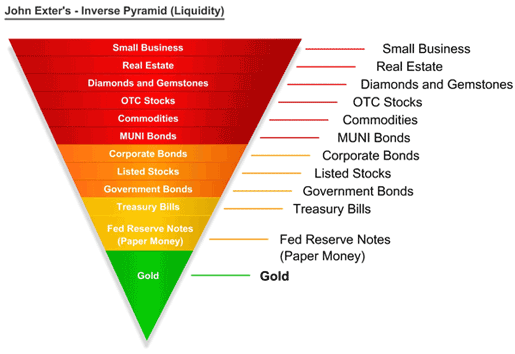
But my point is that the market works by exerting the maximum amount of pain on the maximum amount of people, and the thing that the fewest people expect is the thing that invariably happens. What if in 6 months time the DXY was back at the early-2009 highs? What if the Dow was below 6,500? What if the Fed indeed turned out to be impotent and a wave of private sector deleveraging overwhelmed their re-flation efforts? What if the rally since March turned out to have been driven by a temporary rise in optimism that was merely encouraged by the Fed? What if this has just been a bear-market rally within a longer-term debt-deflation spiral and the continued evaporation of the global debt pyramid?

Monday, 19 October 2009

PBOC Backing Itself Into A Corner

While the Chinese Composite may be lagging in this global equity market frenzy, Chinese economic data is certainly fuelling it. Last week’s monetary data from the PBOC confirmed the willingness of Chinese policymakers to throw all they can at the economy in a bid prolong the current economic boom they are borrowing from the future.


M2 money supply grew by 29.3% y-o-y in September, up from 28.4% in August, and new loans rose to CNY516.7bn (see chart above). This is a truly shocking rate of monetary expansion, and unless the laws of economics have changed, it is fostering a bubble that could jeopardise China’s long-term growth story.

V-Shaped Recovery, But At What Price?
True, the economy is growing rapidly at present as a direct result of this wave of liquidity. Recent import data and figures for electricity consumption (which rose 10.2% y-o-y in September according to the China Electricity Council) suggest a V-shaped recovery is well underway. However, loose monetary policy is exacerbating the current imbalance between consumption and production, while fuelling a destructive asset bubble. This is because new money is being directed overwhelmingly towards investment spending and speculation rather than consumption. Also, the future burden of rising non-performing loans in the banking system (resulting from the rise in malinvestment associated with rapid credit expansion) will likely be felt by consumers, who will be forced to accept a higher loans-deposits spread to recapitalise the banking sector.

Addicted To Credit
This puts the PBOC in a tight spot to say the least. In order for monetary policy to continue to support the real economy, credit growth will have to accelerate. A moderation in the rate of credit expansion, as Hayek explained, will result in recessionary symptoms. A slowdown would thus jeopardise the entire Asian and global economic recovery. On the other hand, an acceleration of credit growth would further fuel the unsustainable bubble, deepen the consumption-investment imbalance, and sow the seeds for an economic and financial crisis.

The Chinese government appears to be banking on a timely recovery in global demand that would allow exports to pick up the slack as it cools investment spending next year. However, global demand of the kind seen 18 months ago is not coming back. The only reason Chinese exports are currently rebounding is because Chinese imports are temporarily boosting the economies of its main trading partners. Once China itself begins to apply the brakes, there will be no driver of demand to soak up the increased supply. What the government needs to do is bite the bullet and take the recession that is due. This is the only way that the economy will be able to reorganise itself into a sustainable production model. At present, though, this seems highly unlikely.

Sunday, 11 October 2009

What's Behind The Stock Market Rally?


The above is a chart I found over at Jesse's Cafe Americain, a good blog. It shows how the current equity rally is been dirven by monetary inflation that is not finding its way to the real economy, but to asset markets. As a result, the S&P500earnings multiple has risen to the highest level ever. I suppose if you can have a 'jobless economic recovery' you can easily have an 'earningsless bull market'.

Saturday, 10 October 2009

Australia: Hiking Rates… But For What Reason?

The Reserve Bank of Australia (RBA) hiked interest rates on Tuesday, from 3.00% to 3.25%, in what appears to have marked the first act of monetary tightening since the 25 basis point hike by the ECB back in August 2008.

I salute the RBA. Unlike the rest of the global central banking community, it has shown an ability and a willingness to act pre-emptively to tame asset price inflation. Rather than sit idly by and watch house prices soar to bubble levels and deal with the subsequent bust, it has been pro-active, and this prudence should underpin the currency and lay the foundations for sustainable economic recovery.

HOWEVER, the key question is why did the RBA hike? If the RBA acknowledges that higher interest rates will encourage savings and prevent another asset price bubble, and is willing to bite the bullet and sacrifice near-term growth to avoid this fate, then well played indeed. However, if the RBA thinks that the economic slump has passed and growth will accelerate from here, and as such inflation is the larger threat, I fear the worst.

Household debt in Australia is larger than that in the US relative to GDP, and private sector deleveraging has only just begun. If this deleveraging process goes into full swing, the RBA may find that it overestimated Australia’s growth outlook, and move swiftly to reverse the hike, much like the ECB did not so many months ago.

Saturday, 3 October 2009

Nikkei: Structural Bear Beats Cyclical Bull

After breaking through support the Japanese Nikkei index looks under serious pressure, with 9,700 the next level to watch. Fundamentally, the economy is a disaster, as weak global demand continues to expose the domestic deflationary stagnation. The recent high of 10,800 looks likely to have marked the cyclical high for Japanese equities, which would mark yet another lower high. A lower low is coming.


There have been a number of factors weighing on the Nikkei in recent days. The unexpected improvement in Japan’s unemployment rate, which fell from 5.7% to 5.5% in August, has been outweighed by a confluence of negative factors. Firstly, the stronger yen, driven partly by Finance Minister Hirohisa Fujii’s comments that a strong currency has generally been good for the economy because it has boosted domestic purchasing power, was a major driver. The poor Tankan survey results, which showed large businesses are aiming to cut spending by 10.8% this year, more than the 9.4% planned three months ago, also hurt market sentiment. The two largest forces weighing on the market, however, which pose a serious threat going forward, were the Chicago PMI data suggesting that the US economy remains in depression, and Japanese CPI data confirming that domestic deflation is deepening.


Export Dependence Remains Key Risk
These two factors sum up the struggles facing the Japanese economy. Starting with the fall in the Chicago PMI, this shatters any hope of a sustainable US andglobal recovery – something which the Japanese economy (and export-sector dependent equity markets), has relied heavily on in recent years to revive it from its deflationary stagnation. With the help of the weak yen (thanks to the carry trade) and strong global demand, the Japanese economy and the Nikkei staged a respectable recovery from 2003 to 2007, with the latter rallying 140% from peak to trough, as exporters lead the way. The current outlook, however, with a strong yen and weak external demand, is far less sanguine.

Deflation Accelerating
With that in mind let me turn your attention to the recent inflation data. As the accompanying charts show, Japan is clearly stuck fast in deflation. Core CPI came in at -2.4% y-o-y in August, the largest fall on record, and the September Tokyo CPI showed a similarly worrying trend. While the year-on-year figure fell by 2.0%, the actual index shows the extent of the deflationary mire that the economy remains in. The price index is the same level now as it was in 1992, and has fallen a staggering 9.5% since the October 1998 high.


Misguided Policies Mean A Slow And Painful Death
As underlying fundamentals of the Japanese economy continue to deteriorate, and deflation continues to trump re-flation efforts, any signal that global demand is waning is likely to weigh heavily on the Japanese economy and asset markets. It was no surprise that the Japanese economy contracted more than any other developed market in Q109 when the pillar of external demand gave way. Indeed, the failure of macroeconomic policies in the wake of the asset price collapse of the 1990s has been partially hidden by the strong export sector, while fostering a climate of mild and protracted deflation. The government has sought to reduce the debt load of the corporate sector and expand that of the public sector to fill the gap in demand. While low interest rates have prevented a debt-deflationary spiral similar to the Great Depression, they have also failed to force about the necessary liquidation of malinvestments created during the bubble era. As such, while public debt has ballooned, corporate debt remains high. The economy is no closer to embarking on a sustainable recovery as the private sector is yet to work off its imbalances and the public sector has created a host of new ones.


Cyclical High Is In
Continued core deflation has been a symptom of the asset bubble bursting, and has come in spite of the inflationary policies pursued by the government. The large liquidity-fuelled cyclical rallies seen in the Nikkei have brought lower highs and lower lows, as the underlying fundamentals have continued to deteriorate. It is looking increasingly likely that the recent high of 10,800 will mark the top of this cyclical (rather than secular) bull market, which could open up much further downside for the index. While continued price deflation – a sign that the economy is trying to heal itself – will help to support real incomes, it is likely to result in further asset price weakness in Japan over the medium term. The sooner this occurs, though, the sooner a sustainable recovery will be enjoyed.

Wednesday, 30 September 2009

Krugman Still Believes In A Free Lunch

http://krugman.blogs.nytimes.com/2009/09/28/crowding-in/

There are so many things wrong with the above analysis.

The article is about how, in times like these, when we are ‘living is special conditions’, crowding out happens in reverse. That is, the government spending our money, when we don’t want to, actually makes us better off, not just now but also in the future. ie more consumption now leads to more consumption later. Of course this is not and cannot be true because it violates the first rule of economics: There is no such thing as a free lunch.

Regardless of whether or not he/she has a PhD or not, always be wary of an economist who tries to say that the 'it’s different this time' with regards to economic theory. True (Austrian) economic theory does not change, and when Keynesians use words like ‘crowding in’, ‘liquidity trap’, ‘paradox of thrift’ and ‘animal spirits’ it’s usually because they don’t understand what is really going on.

Krugman’s second point really sums up his lack of understanding:

(2) Crowding out: when it runs deficits, the government competes with the private sector for funds, so deficits crowd out private investment, which reduces potential growth.


It isn’t just funds that the private sector competes with the public sector for. When the public spends our money it uses up resources, (land, labour, capital), which prevents the private sector from employing them more efficiently. For a more in depth analysis of why public sector stimulus is no free lunch visit here:

http://www.riskwatchdog.com/2009/06/11/a-return-to-logic-a-critique-of-the-krugman-lecture-series/


Without fiscal spending, investment does take place, just at a lesser rate than is needed to make use of all the idle resources. It’s not only that the productivity of government-sponsored investments are below what could be hypothetically achieved by the private sector, it is that these ‘investments’ (more like consumption in reality) would hinder investment by the private sector now and in the future. Assuming that there is no crowding out in the present period (i.e. assuming that private demand does not fall as people expect higher taxes in the future and that Treasury yields do not rise due to the excess saving), I have no issue with the claim that higher fiscal spending makes a country better off in the present by raising demand. As an example, having masses of unemployed workers who could be contributing in some way makes no sense in the present. It’s obvious that the more we spend right now the better off we are right now, we don’t need Krugman to tell us this. The problem is we do not live in just one period. While I know that my ‘excess’ saving is not improving my wellbeing in this period, I am doing it because it will improve the discounted net present value of my future wellbeing. This is as true for an economy as it is for an individual.

Friday, 25 September 2009

Seeking Safety In Aussie Bonds

Despite the current re-flation attempts by the world's monetary policymakers, I still see deflation as the overriding theme going forward, owing to private sector deleveraging. With this in mind, Australian long duration bonds look particularly attractive for a number of reasons:

1. Yield Looks Attractive:
The current yield on the Australian 10-year bond is an attractive 5.4%, having risen from a low of 3.7% in December 2008, and is back to levels seen in 2006 when the global credit binge was in full swing. The nominal yield compares with the trailing dividend yield of 4.2% for Australia's ASX200 equity index.

2. Public Sector In Credit, Private Sector In Turmoil:
At the end of 2008, the Australian government was actually a net creditor, with net assets of roughly 7% of GDP. While the figure is likely to deteriorate this year as a result of the fiscal stimulus measures, the government's net debt ratio is still expected to remain in balance. This is extremely rare in today's world, and compares very favourably with Japan (95%), Italy (90%), and the US (60%) according to OECD figures.

By comparison, Australia's private debt burden is massive. Having peaked at roughly 165% of GDP in 2008, it has since fallen to around 150% and remains at twice the level seen at the start of the Great Depression. While government handouts have helped support private sector demand so far this year, a major private sector deleveraging process has begun, which will see savings rates rise for years to come. Indeed, the household saving ratio rose to 3.6% in Q209, continuing the uptrend seen since 2002 when the rate reached a low of -4.0%. This should continue rising towards the long-term average rate of 7.6%, with an overshoot highly likely. This could make for a perfect storm in the long-term government debt market.

3. Prudent Policy Limits Inflation Risk:
Unlike in the US and UK, where there is a huge risk that policymakers will continue to try everything they can to devalue their currencies to combat the ensuing deflationary forces, the Reserve Bank of Australia (RBA) is likely to continue acting relatively prudently. The Australian government has also been less willing to assume the debts of the corporate sector than the US and UK governments, which should keep gross debt levels low over the coming years. The government, which has run surpluses in its fiscal accounts for the past decade, will run a nominal fiscal deficit of 'just' 4.6% of GDP this year, way below the double-digit levels of the US and the UK. The relatively low willingness to take on more debt should continue to drive down perceived default risk at a time when other developed world governments are facing heightened default concerns.

JGB Bull Run Nearing An End?
One way to hedge the near-term risk would be to take a bearish stance on Japanese 10-year government bonds, as we see increasing potential for yields here to rise over the medium term.
I know I am not the only ones over the past decade to suggest that the bull market in Japanese government bonds could be ending. However, given the continued deterioration in the economy, this is becoming increasingly likely. Indeed, it is not inconceivable that Japan's balance of payments surplus could turn to a deficit, such is the weak outlook for global demand, which would likely force the Japanese government to offer higher interest rates on its debt in order to entice savings from overseas. On the contrary, we could also see Australia's current account deficit flip to a surplus as the private sector pays down the external debt it has accumulated from decades of current account deficits. This would add to the forces driving down long-term yields.

Australia More Creditworthy
Supporting my view that Australian long-term bonds will outperform those of Japan going forward is the current 10-year bond interest rate differential. At 411bps the spread is historically high and we believe that it is nearing its cyclical peak. What is more, given that the CDS market is currently pricing in a higher default risk in Japan than in Australia (and rightly so), this highlights the attractiveness of the current sovereign bond spread in terms of default risk.